
The first truly cold evening has a way of changing the rhythm of the kitchen. Windows are drawn earlier, the light softens to amber, and the appetite begins to ask for something deeper, earthier, more nurturing. Wild mushroom season answers beautifully. Few dishes suit that moment better than a risotto, whose slow stirring, fragrant steam and silken finish feel made for autumn’s first chill. It is a dish that rewards patience, celebrates seasonality and turns a modest supper into something quietly luxurious.
At its best, wild mushroom risotto is not heavy, but layered. The rice should remain distinct yet creamy, the mushrooms browned rather than steamed, the broth clear and savoury, the finish glossy with butter and Parmigiano Reggiano. The beauty lies in restraint. When the ingredients are good, there is no need for embellishment beyond perhaps a final flourish of thyme, parsley or a drizzle of excellent olive oil. It is comfort food, certainly, but with the composure and finesse of an evening meal served under linen and low light.
Wild mushroom season and why it matters
Wild mushroom season arrives with a sense of anticipation because the flavours are so different from the cultivated varieties found year-round. Depending on region and conditions, the season may bring chanterelles, ceps, girolles, trompettes de la mort, morels or hedgehog mushrooms. Their character ranges from nutty and honeyed to smoky, woodsy and faintly peppery. In a risotto, these nuances matter. They create the depth that makes the dish feel unmistakably autumnal.
For those who enjoy travelling for food, this is also one of the pleasures of the season. In Italy, particularly in the north, markets in regions such as Piedmont, Lombardy and the Dolomites often display baskets of foraged mushrooms when the weather turns. France, too, has a strong mushroom culture, with seasonal finds appearing in regional markets and restaurant menus. Even in Britain, good greengrocers and farm shops increasingly stock foraged varieties, and the change in the produce aisle is one of the surest signs that the season has turned.
Freshness is essential. Wild mushrooms are at their most expressive when they are clean, firm and fragrant, with no dampness or sliminess. The aroma should be forest-like and savoury, not musty. If foraging is part of your own autumn ritual, it is important to rely on expert identification and local guidance, because wild mushrooms demand respect as much as enthusiasm.
Choosing the right rice for a proper risotto
A successful risotto depends on the rice as much as the mushrooms. Carnaroli is often considered the gold standard, because it holds its shape beautifully while releasing starch gradually for that signature creaminess. Arborio is more widely available and still produces an excellent result, though it can soften more quickly if overcooked. Vialone Nano is another refined choice, especially for those who prefer a looser, silkier texture.
The point is not to create porridge, nor to leave the dish dry. A proper risotto should move slowly across the plate, relaxed but structured. That balance comes from steady stirring, good stock and careful timing. Use a light vegetable or chicken stock, kept hot in a separate pan, so each ladle warms the rice without cooling the cooking process. Add it gradually and allow each addition to be absorbed before the next. This unhurried method is part of the pleasure, especially on the first evening when the cold begins to settle in.
A risotto built for depth, not excess
Wild mushroom risotto works best when the flavours are allowed to sing without competition. Onion or shallot should be softened gently in butter or a little olive oil, without browning. The rice is then toasted briefly, a small but important step that helps preserve texture. A splash of dry white wine brings brightness, though it should be cooked off fully before the stock is added.
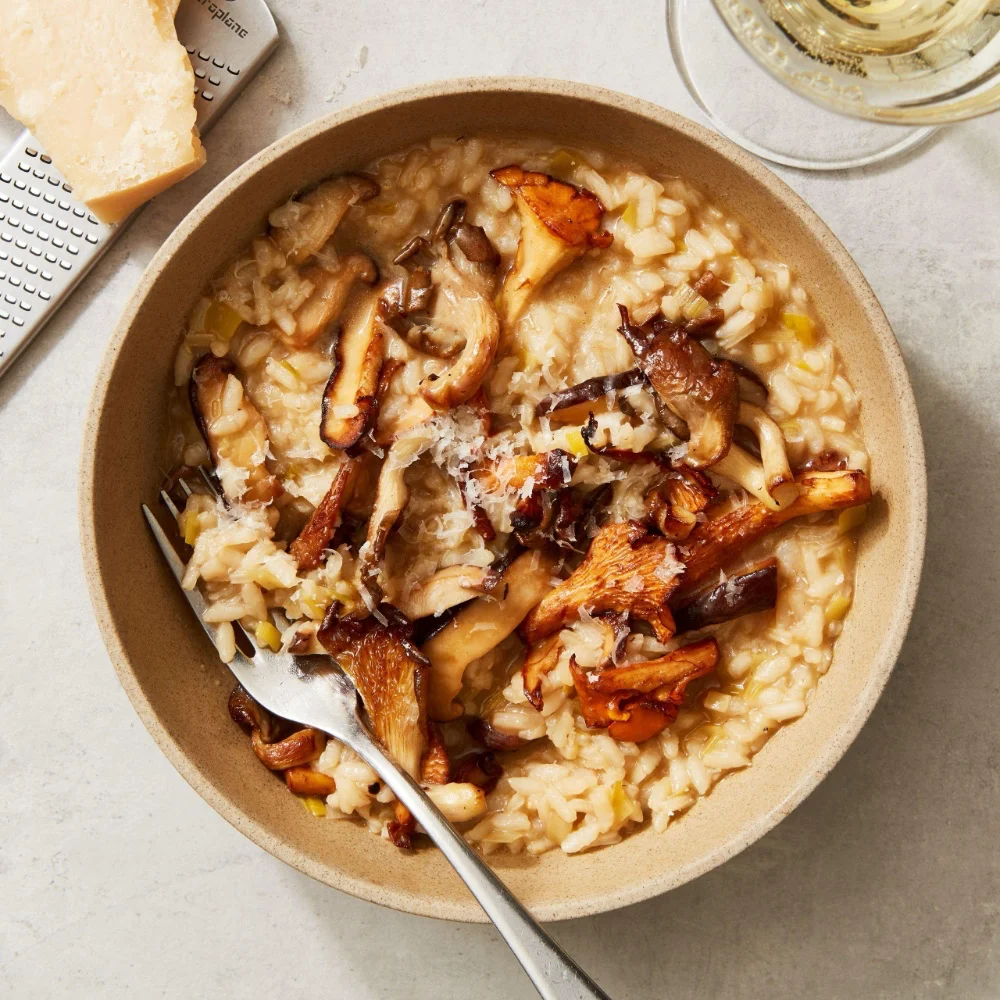
The mushrooms deserve separate treatment. Sauté them in batches in a hot pan so they colour properly and do not release too much moisture at once. This is where the flavour concentrates: edges caramelise, moisture evaporates, and the kitchen fills with that unmistakable woodland scent. A little garlic can be used sparingly, but it should never dominate. The aim is to preserve the subtlety of the mushrooms themselves.
When the rice is nearly ready, fold the mushrooms back in and finish with butter and grated Parmigiano Reggiano. A final resting minute off the heat allows the risotto to settle into its ideal texture. If desired, a touch of mascarpone may make the dish even more luxurious, though it is not essential. The elegance of this recipe lies in knowing when enough is enough.
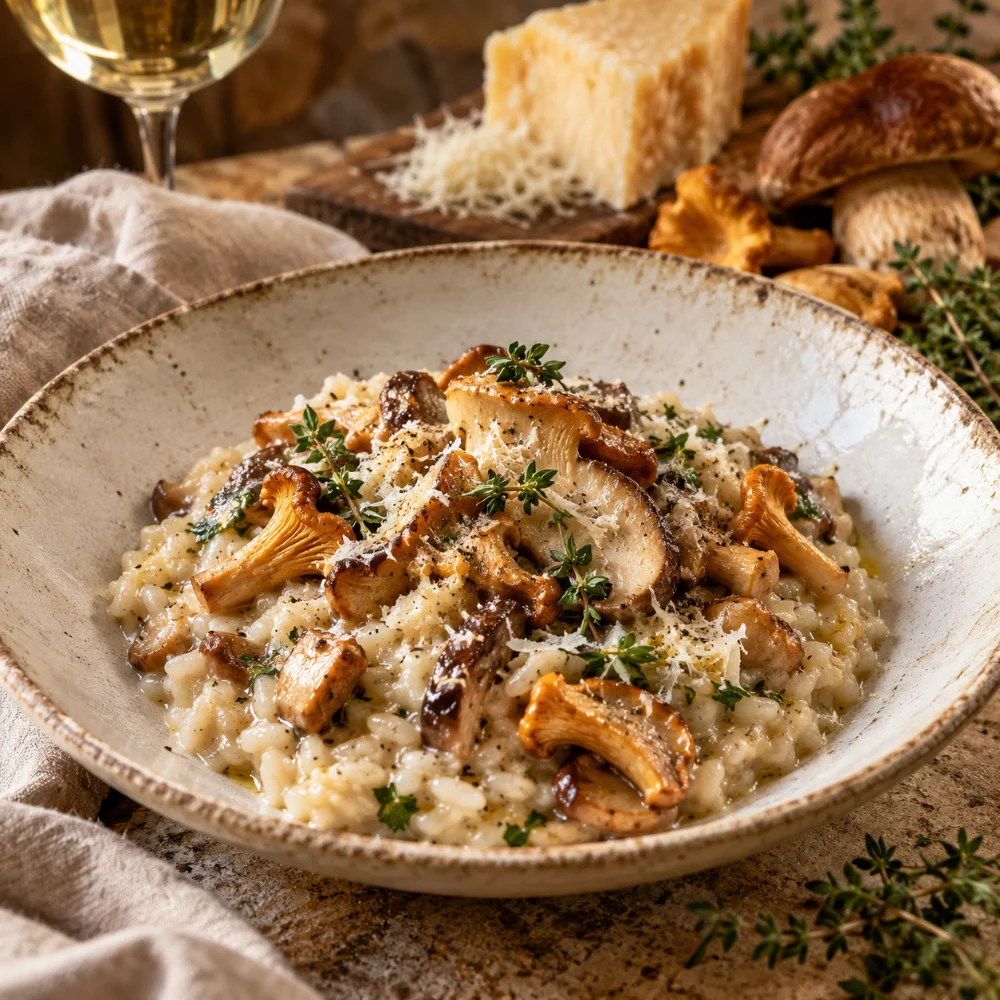
Wild Mushroom Risotto with Thyme & Parmigiano Reggiano
A comforting autumn classic with earthy mushrooms, delicate herbs and a beautifully silky finish.
Servings: 4
Preparation time: 15 minutes
Cooking time: 30 minutes
Total time: 45 minutes
Ingredients
- 320 g Carnaroli rice
- 400 g mixed wild mushrooms, such as porcini, chanterelles or girolles
- 1 litre vegetable or light chicken stock, kept hot
- 2 shallots, finely chopped
- 1 garlic clove, lightly crushed
- 100 ml dry white wine
- 60 g unsalted butter
- 2 tbsp extra virgin olive oil
- 60 g Parmigiano Reggiano, freshly grated
- 3 sprigs fresh thyme
- 2 tbsp flat-leaf parsley, finely chopped
- Sea salt and freshly ground black pepper
- Optional: finely grated lemon zest
Method
1. Prepare the mushrooms
Gently brush the mushrooms clean and slice larger varieties into generous pieces. Heat the olive oil and 15 g of butter in a frying pan. Sauté the mushrooms in batches over medium-high heat until golden. Add the garlic and thyme during the final minute, season lightly and set aside.
2. Build the foundation
Melt 20 g of butter in a heavy-based saucepan over medium-low heat. Add the shallots and cook gently for 3-4 minutes until translucent. Stir in the Carnaroli rice and toast for 2 minutes, allowing each grain to become lightly coated.
3. Add the wine and stock
Pour in the white wine and stir until almost completely evaporated. Begin adding hot stock one ladle at a time, stirring regularly. Allow most of the liquid to absorb before adding more. Continue for approximately 16-18 minutes, until the rice is creamy but retains a gentle bite.
4. Bring everything together
Fold three-quarters of the sautéed mushrooms into the risotto during the final 2 minutes of cooking. Remove from the heat and stir in the remaining 25 g of cold butter and the grated Parmigiano Reggiano. Add a little hot stock if necessary to achieve a flowing, silky consistency.
5. Finish and serve
Rest for 1 minute, then spoon into warm, shallow bowls. Garnish with the remaining mushrooms, fresh parsley, a few thyme leaves and freshly ground black pepper. Add a touch of lemon zest if desired. Serve immediately.
The La Dolce Vita Touch
For an especially fragrant finish, reserve a few perfectly browned porcini slices for each plate. A drizzle of excellent extra virgin olive oil and a glass of elegant Soave Classico turn this simple autumn supper into a memorable occasion.
Simple refinements that make a difference
For a more aromatic risotto, infuse the stock lightly with thyme stalks or a bay leaf. A small amount of finely chopped parsley added at the end lifts the richness. Some cooks enjoy a hint of lemon zest, which can brighten the whole dish without making it taste sharp. If you wish to add complexity, a few drops of truffle oil are sometimes used, but with caution, as its perfume can overwhelm delicate mushrooms rather than enhance them.
For a more indulgent version, finish with a few flakes of sea salt and a little extra butter. For a lighter plate, serve the risotto with a simple green salad dressed in lemon and olive oil. Both approaches work, provided the balance remains elegant and thoughtful.
What to serve with wild mushroom risotto
Because the risotto is rich and satisfying, it pairs beautifully with restraint elsewhere on the table. A crisp white wine such as a good Chardonnay, Soave or Pinot Grigio can complement the earthiness of the mushrooms without overwhelming them. Those who prefer red may choose something gentle and polished, perhaps a light Pinot Noir or a cool-climate red with supple tannins.
Accompaniments should remain understated. Roast autumn vegetables, sautéed cavolo nero or a few shavings of mature cheese can provide contrast without distraction. For a dinner that feels more formally composed, the risotto may serve as a first course before roast poultry or braised meats. For a quieter supper, it stands entirely on its own, especially when served in shallow bowls that retain heat and encourage a leisurely pace.
Presentation matters more than one might think. A sprig of thyme, a scattering of chopped herbs and a final drizzle of good oil are enough. The visual appeal should suggest warmth, abundance and simplicity, not excess.
Why this dish belongs to the first cold evening
There is something deeply satisfying about cooking a dish that matches the weather so precisely. Wild mushroom risotto suits the first cold evening because it asks for a little attention and gives back far more in comfort. It is tactile, fragrant and quietly restorative. The stirring slows the evening down. The steam fogs the kitchen glass. The first spoonful brings warmth from within, and the mushrooms carry the taste of the season itself.
In a world that often favours speed, this is a dish that insists on presence. It is not complicated, but it is attentive. It belongs to those evenings when the coat is left on the chair by the door, the candles are lit earlier than expected and dinner becomes part of the pleasure of the season. Wild mushroom risotto, properly made, is not merely a recipe for autumn. It is the beginning of it.