
The Shingles Vaccine and Dementia: What the Research Really Says
Could a vaccine designed to prevent a painful skin condition also help protect the ageing brain? It is a question attracting growing scientific attention, following research suggesting that people vaccinated against shingles may have a lower risk of developing dementia.
For anyone approaching their fifties, sixties or beyond, the possibility is intriguing. Dementia remains one of the most challenging health concerns associated with ageing, and the search for effective ways to reduce its risk has become increasingly urgent.
Yet there is an important distinction between a promising scientific discovery and an established medical benefit. While several studies have reported encouraging results, researchers have not yet demonstrated through randomised clinical trials that shingles vaccination prevents dementia.
Understanding what the evidence actually tells us is therefore more valuable than the headlines alone.
Why the Shingles Vaccine Is Attracting Attention
Shingles, medically known as herpes zoster, is caused by the varicella-zoster virus, the same virus responsible for chickenpox. After the initial infection, the virus remains dormant within nerve tissue, sometimes for decades.
1:1As the immune system changes with age, the virus can reactivate, producing a painful, blistering rash, usually affecting one side of the body. For some people, the discomfort disappears within weeks. Others experience postherpetic neuralgia, a form of persistent nerve pain that can continue for months or even years. Shingles can also cause serious complications, particularly when the eyes are affected.
Vaccination has an established role in reducing the likelihood of shingles and its complications. The recombinant shingles vaccine, Shingrix, has demonstrated high effectiveness against shingles in clinical trials, including among older adults.
More recently, however, scientists have begun investigating whether preventing viral reactivation might offer benefits extending beyond the skin and nervous system. The emerging connection with dementia has generated considerable interest, particularly because it raises questions about the possible relationship between infections, inflammation and long-term brain health.
The Shingles Vaccine and Dementia: What Studies Have Found
Some of the most compelling findings have emerged from large population studies examining dementia diagnoses among people who received shingles vaccinations.
A 2024 study published in Nature Medicine examined health records from more than 200,000 people in the United States. Researchers compared individuals who received the newer recombinant shingles vaccine with those who had received the older live vaccine.
Over a six-year follow-up period, the recombinant vaccine was associated with approximately 17 per cent more time lived without a dementia diagnosis. That finding was notable, although it did not mean that vaccinated individuals had a 17 per cent lower absolute probability of developing dementia. The study measured differences in dementia-free time, which is a distinct outcome.
Another important investigation, published in Nature in 2025, examined a vaccination programme in Wales. The programme introduced eligibility according to a specific birth-date threshold, creating an unusual opportunity for researchers to compare people who were very similar in age but differed in their eligibility for vaccination.
The researchers found that eligibility for the older live shingles vaccine was associated with a reduction in new dementia diagnoses over approximately seven years. Their analysis estimated a reduction of around 3.5 percentage points in the probability of receiving a dementia diagnosis among those eligible for vaccination.
Unlike a conventional observational study, this natural experiment reduced some of the usual problems associated with comparing people who independently choose whether to be vaccinated.
Nevertheless, it was not a randomised clinical trial specifically designed to establish dementia prevention. The distinction matters. These findings strengthen the case for further investigation, but they do not yet establish dementia protection as a proven benefit of shingles vaccination.
Why Researchers Are Interested in the Virus-Brain Connection
The possibility that viral infections influence dementia risk is not entirely new. Scientists have long investigated whether infections and the immune responses they provoke might contribute to processes involved in cognitive decline.
One hypothesis concerns neuroinflammation, the inflammatory activity occurring within the brain and nervous system. Inflammation is a normal part of the body’s defence against infection. However, persistent or poorly regulated inflammatory responses may contribute to neurological damage.
Because the varicella-zoster virus remains within nerve tissue, researchers are interested in whether repeated viral reactivation could influence neurological health over time. Preventing shingles might therefore reduce certain inflammatory or vascular complications that could otherwise affect the brain.
Another possibility is that vaccination influences immune responses in ways that extend beyond protection against shingles itself. These explanations remain hypotheses rather than established mechanisms.
Dementia is also not a single disease. Alzheimer’s disease, vascular dementia and other forms of cognitive impairment involve different biological processes, often overlapping in older adults.
A reduction in overall dementia diagnoses does not automatically reveal which of these processes might be affected by vaccination.
Why Different Studies Produce Different Results
One reason the shingles vaccine research requires careful interpretation is that studies have examined different populations, vaccines and outcomes.
The older live shingles vaccine, Zostavax, differs substantially from Shingrix, the recombinant vaccine now widely used in many countries. The two vaccines contain different components and produce different immune responses. Findings involving one vaccine cannot automatically be transferred to the other.
Study design also plays a crucial role. People who receive recommended vaccinations may differ from those who do not. They might attend preventive healthcare appointments more regularly, have better access to medical services or follow other health recommendations.
These differences can influence dementia risk independently of vaccination. Researchers call this healthy-vaccinee bias, one of several potential sources of distortion in observational research.
Statistical adjustments can reduce such problems, but they cannot always eliminate them. The Welsh natural experiment is particularly interesting because its birth-date eligibility rule helped researchers address some of these concerns.
Even so, uncertainties remain about how the results apply to different populations, healthcare systems and vaccine formulations.
There is also the question of how dementia is identified. Many large studies rely on diagnoses recorded in electronic health records rather than detailed neurological examinations of every participant.
Differences in access to assessment, diagnostic practices and follow-up periods can therefore influence the apparent results.
Taken together, the studies provide an increasingly interesting scientific picture, but not yet a definitive answer.
What Future Clinical Trials May Clarify
The next important step is determining whether the relationship is genuinely causal.
Randomised controlled trials are generally considered the strongest method for evaluating whether a medical intervention produces a particular health benefit. By assigning participants to different interventions through randomisation, researchers can reduce many of the differences that complicate observational studies.
For shingles vaccination and dementia, future research will need to establish whether vaccination directly reduces dementia incidence, whether any benefit differs between vaccine types and which populations might benefit most.
Researchers will also need to understand how long any protective effect might last.
Dementia often develops gradually over many years, making these investigations particularly challenging. A meaningful trial may require substantial numbers of participants and extended follow-up.
Biological studies examining immune responses, viral reactivation and markers of neurological inflammation could provide additional clues.
An important consideration is that a proven vaccine should not be withheld from people who need it simply to create an untreated comparison group. Future trials must therefore be designed around appropriate ethical and clinical safeguards.
Until stronger evidence becomes available, the dementia findings should be viewed as a promising research direction rather than a new indication for vaccination.

Who Should Consider Shingles Vaccination After 40?
For adults approaching middle age and beyond, the practical question is less about dementia prevention and more about established protection against shingles.
Vaccination recommendations vary between countries and depend on age, medical history and immune status.
In the United States, the Centers for Disease Control and Prevention recommends two doses of Shingrix for adults aged 50 and older. It is also recommended for adults aged 19 and older who have weakened immune systems because of disease or treatment.
In the United Kingdom, NHS eligibility follows a different age-based programme, with additional provisions for people who are severely immunosuppressed.
Across Europe, national vaccination schedules and reimbursement arrangements vary. In the Netherlands, eligibility and access should be considered in the context of current national recommendations, individual medical circumstances and whether vaccination is publicly funded or privately arranged.
Having experienced shingles previously does not necessarily remove the potential benefit of vaccination, although the appropriate timing should be discussed with a healthcare professional.
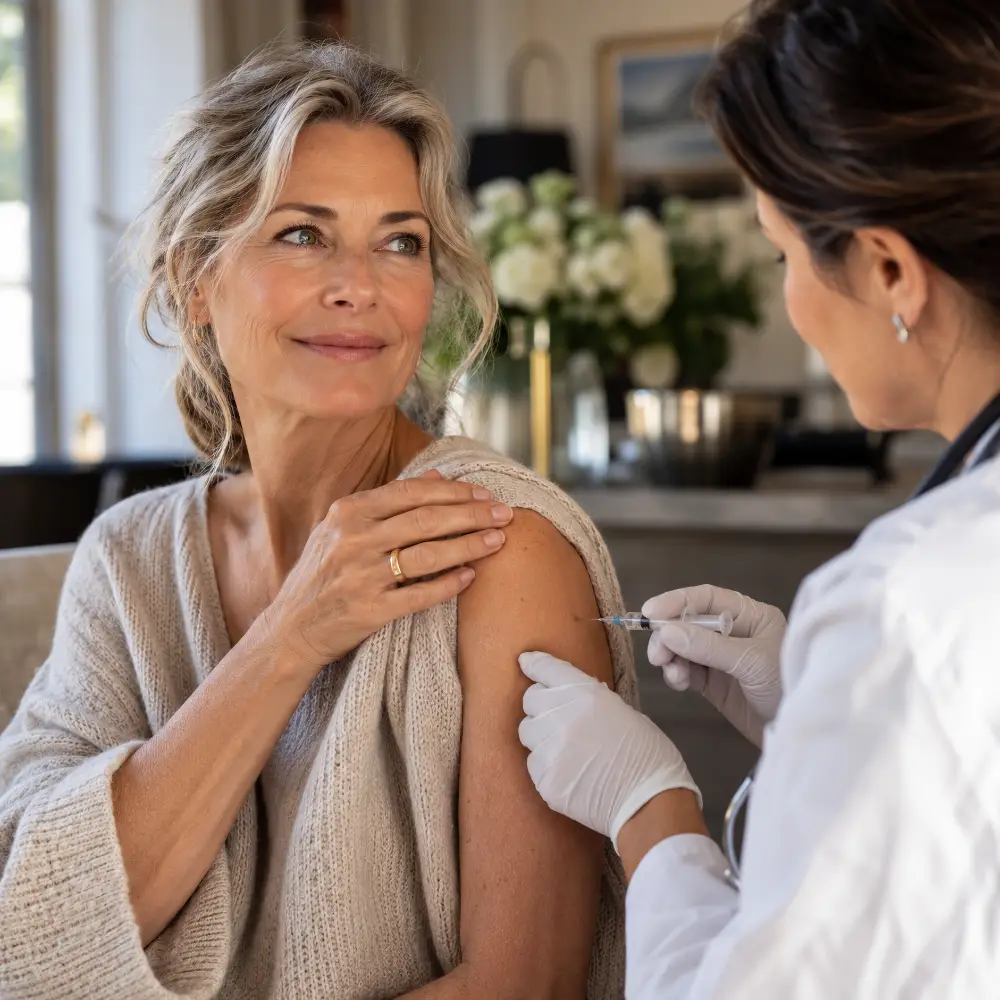
Shingrix is administered as a two-dose course. Common side effects include soreness at the injection site, fatigue, headache, muscle aches and sometimes fever. These reactions generally resolve within a few days.
As with any vaccine, individual circumstances matter. A clinician can assess suitability, including previous allergic reactions, immune conditions and the timing of other treatments.
Importantly, the possibility of dementia protection is not currently an established reason to depart from recommended eligibility criteria.
Where Shingles Vaccination Fits into Brain Health
The emerging research is especially interesting because dementia prevention increasingly involves looking beyond the brain itself.
Cardiovascular health, hearing, physical activity, sleep, metabolic conditions and social engagement all influence aspects of cognitive health.
The 2024 Lancet Commission on dementia prevention identified 14 potentially modifiable risk factors associated with dementia across the lifespan. These include high blood pressure, smoking, physical inactivity, diabetes, hearing loss, social isolation and elevated LDL cholesterol in midlife.
Addressing such factors does not guarantee that dementia can be prevented. Nevertheless, they represent areas where evidence already supports practical preventive measures.
Shingles vaccination occupies a different position. Its effectiveness against shingles is well established, while its possible contribution to dementia prevention remains under investigation.
That distinction should guide how the findings are interpreted. The vaccine is not a substitute for managing blood pressure, maintaining physical fitness or addressing other recognised risk factors.
Nor should people assume that receiving it provides measurable protection against Alzheimer’s disease.
The potential additional benefit is scientifically interesting precisely because it remains an open question.
A Promising Discovery, Not Yet a Proven Prevention
Medical research rarely advances through a single dramatic revelation. More often, understanding develops through a succession of carefully examined findings, each answering one question while raising several others.
The shingles vaccine and dementia research is a compelling example.
Large observational studies have identified an association worth taking seriously. A natural experiment has strengthened the evidence, while investigations into viral activity and inflammation offer plausible biological explanations.
What remains missing is definitive randomised evidence that vaccination prevents dementia.
For adults over 40, the most useful conclusion is therefore a measured one.
Shingles vaccination already offers meaningful protection against a condition that can cause considerable pain and lasting complications. Whether it also provides protection against cognitive decline is a possibility that future research may clarify.
In a field where genuinely effective preventive interventions are urgently needed, that possibility deserves attention.
But the real value of the science lies in understanding both its promise and its limits.