

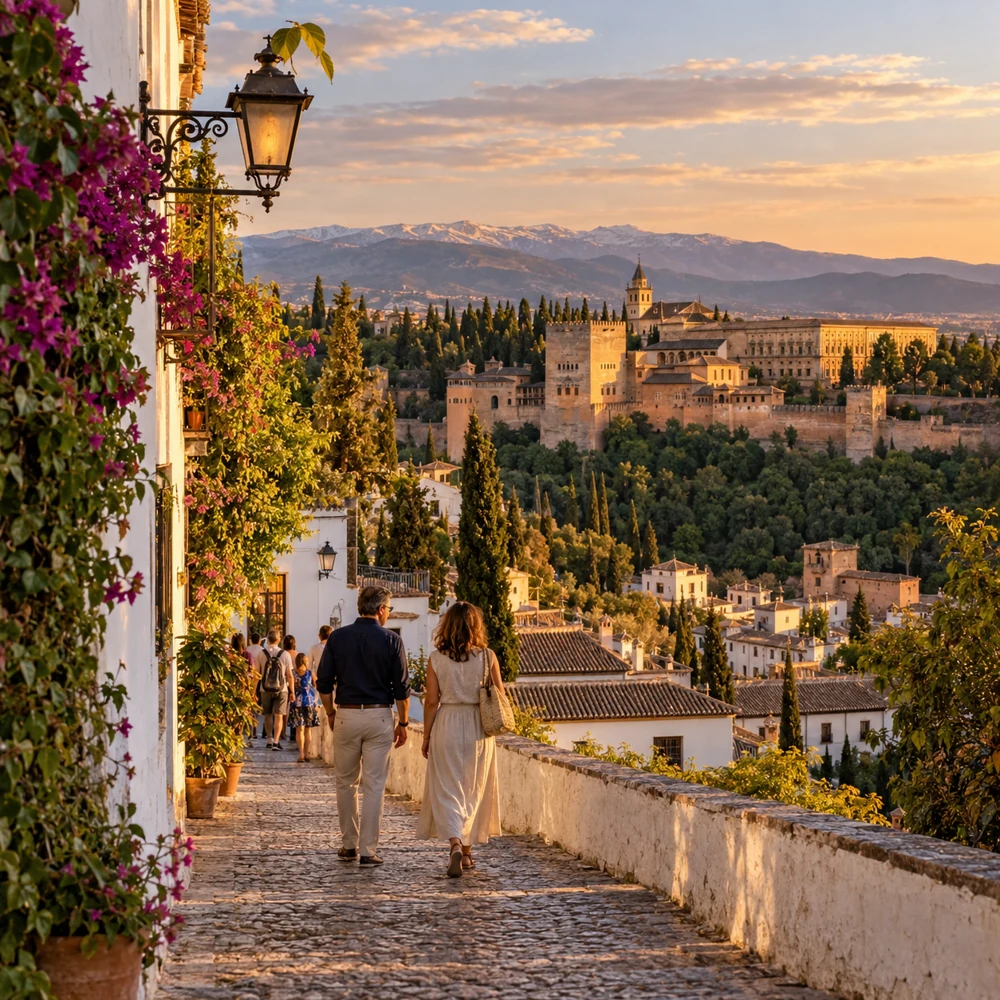
Granada has a way of revealing itself slowly. Set against the Sierra Nevada and threaded with the memory of Moorish courts, Catholic monuments and lively tapas bars, the city feels both intimate and grand. For travellers wondering how to spend two days in Granada, the answer lies in balancing its most celebrated sights with time for the quieter pleasures that make Andalusia so memorable: a shaded courtyard, a glass of local wine, the scent of jasmine drifting through narrow streets, and a long, considered lunch.
Two days is enough to experience the city’s essential character, provided you move with intention. This is not a place to rush. Granada rewards those who linger, whether in the intricate stillness of the Alhambra, the whitewashed lanes of the Albaicín, or the twilight hush of a traditional tea house.
How to Spend Two Days in Granada: Day One Among Palaces and Old Streets
Begin your first day with Granada’s most famous treasure, the Alhambra. This vast palace-fortress complex is the city’s defining experience, and it deserves unhurried attention. The beauty of the Alhambra lies not only in its scale, but in its detail: carved stucco, patterned tiles, reflective pools and gardens designed to soothe the eye. Arrive early, when the light is soft and the atmosphere still carries a sense of calm before the day gathers pace.
Within the complex, the Nasrid Palaces are the most exquisite part. Their rooms and courtyards are a masterclass in restraint and ornament, where water, geometry and shadow work together with quiet precision. The Generalife, once the summer retreat of the sultans, offers a more open experience, with terraces and gardens that feel almost restorative after the intensity of the palaces. Comfortable shoes are essential, as the site involves plenty of walking, steps and uneven surfaces.
A refined lunch in the city centre
After a morning at the Alhambra, head back into the city for lunch. Granada has a strong tapas culture, and one of its pleasures is that a drink is often accompanied by a complimentary small plate. For a more polished midday meal, choose somewhere that focuses on Andalusian produce: olive oil, jamón, grilled vegetables, seafood and seasonal salads. A leisurely lunch allows time to absorb the city’s rhythm before continuing into the afternoon.
In the early afternoon, explore the Realejo, the former Jewish quarter, where narrow streets open unexpectedly onto plazas and walls are painted with street art. It offers a slightly different mood from the more historic centre, less formal, more contemporary, and useful for understanding Granada as a living city rather than a preserved monument. From here, continue towards the Albaicín, the oldest Arab quarter, where the streets are steeper, narrower and beautifully irregular.
Sunset from the Albaicín
The Albaicín is one of the finest places in Granada to end the day. Its white houses, iron balconies and hidden gardens create a feeling of timelessness, while the views across to the Alhambra are simply unforgettable. Walk towards the Mirador de San Nicolás in the late afternoon, when the palace complex catches the fading light and the Sierra Nevada often appears in the distance, its peaks softly luminous.
This is one of those moments that captures Granada at its most atmospheric. Street musicians may be playing nearby, cafés fill with conversation, and the city seems to exhale as the temperature cools. From here, enjoy dinner in the Albaicín or descend towards the centre for a restaurant specialising in modern Andalusian cooking. Dishes such as salmorejo, aubergine with honey, fresh fish and slow-cooked meats showcase the region’s generosity and depth of flavour.
Day Two in Granada: Churches, Markets and Local Flavours
Your second day can be shaped around Granada’s layers of history and its everyday pleasures. Begin in the city centre with the Cathedral and the Royal Chapel, two key monuments that reflect the Catholic era after the Reconquista. The Cathedral’s Renaissance façade and soaring interior feel more monumental than the Alhambra’s delicacy, yet the contrast is part of what makes Granada so compelling. Nearby, the Royal Chapel contains the tombs of Ferdinand and Isabella, an important historical marker for anyone interested in Spain’s past.
From there, wander through the surrounding streets rather than following a fixed route. Granada’s centre is best enjoyed as a sequence of impressions: a bakery window filled with pastries, a tiny shop selling leather goods, a square where locals pause for coffee, the sound of footsteps on stone. If you appreciate markets, make time for the Mercado de San Agustín, where stalls and counters offer everything from cured meats to seafood and cheese. It is an easy place to gather ideas for an impromptu lunch or a simple aperitif.
Where to eat well in Granada
Food in Granada should be part of the journey rather than an afterthought. A second lunch may be more informal than the first, perhaps a tapas crawl through a few carefully chosen bars. This is one of the most enjoyable ways to experience the city, especially if you seek out places with a strong local following. Look for grilled peppers, croquetas, tortilla, marinated anchovies and plates of jamón ibérico served with crusty bread.
For dessert, choose piononos if you would like to taste a classic Granadan sweet. These small pastries, traditionally associated with the nearby town of Santa Fe, are syrupy, rich and beautifully satisfying with coffee. A glass of fino sherry or a local wine can also make an elegant late-afternoon pause.
Evening in Granada: Tea Houses and Twilight Views
As evening approaches, return to the Albaicín or venture into the Sacromonte area, known for its cave dwellings and flamenco heritage. Sacromonte offers a more folkloric face of Granada, with a landscape shaped by history, music and lived tradition. If you wish to see flamenco in an intimate setting, this is the quarter most associated with the art form’s expressive power. Choose a venue with a respected reputation rather than a heavily staged performance, and the experience can be memorable for its emotional force and closeness.
Alternatively, slow the pace with an after-dinner walk and a stop at one of the city’s Moroccan-style tea houses. Granada’s Islamic heritage remains visible in the atmosphere of its oldest quarters, and these tea rooms, with their low seating, patterned textiles and fragrant mint tea, offer a gentle way to end the day. The ritual is simple, yet deeply soothing: warm tea, perhaps a slice of almond cake, and the city outside dimming into night.
Practical tips for a luxurious two-day stay
To make the most of Granada in two days, choose accommodation in or near the city centre, the Albaicín, or close to the Alhambra if you prefer quieter surroundings. Granada is a city of hills and cobbled streets, so location matters. A well-situated hotel saves time and allows for spontaneous breaks between sightseeing and meals.
Plan for a moderate walking pace, with plenty of pauses. The city is best appreciated on foot, but the terrain can be demanding, especially in summer. In warmer months, start early, rest during the hottest part of the afternoon and save the most atmospheric streets for the evening. In cooler seasons, the crisp air and clear views towards the mountains can be especially appealing.
If you are choosing what to prioritise, place the Alhambra first, then the Albaicín, then the Cathedral and Royal Chapel. Everything else can be shaped around these anchors. Granada is rich in detail, but its true luxury lies in proportion: one great monument, one historic quarter, one unhurried meal, one view at sunset.
A city to savour, not simply see
Two days in Granada offer just enough time to understand why the city lingers in the memory. Its beauty is architectural, certainly, but also atmospheric, carried in the sound of fountains, the texture of stone, the taste of tapas and the colour of evening light across the Alhambra. For the discerning traveller, Granada is not merely a destination to tick off, but a place to experience in layers.
If you spend your time well, you will leave with more than photographs. You will carry the feeling of the city itself: graceful, complex, and quietly unforgettable.