
Tonight, the light will change.
On 12 August 2026, the Moon will pass directly between Earth and the Sun, creating a total solar eclipse along a narrow path stretching from Greenland and Iceland towards northern Spain and Portugal. Across much of Europe, the spectacle will be partial, but the effect can still be extraordinary: sunlight softens, shadows sharpen and the familiar landscape briefly takes on an unfamiliar quality.
For a few precious minutes, the usual rhythm of the day gives way to something celestial. It is an occasion worth treating less like an astronomical appointment and more like a beautifully staged evening.
A good chair. A glass of something chilled. A clear view of the western sky. And, above all, enough time to simply look up.
The Eclipse Edit: Make an Evening of It
There is something wonderfully old-fashioned about watching an eclipse. No ticket is required, no restaurant reservation is necessary and the experience cannot be hurried.
If you are watching from somewhere with a partial eclipse, choose a location with an unobstructed view towards the west or west-north-west. In Amsterdam, the partial eclipse begins at approximately 19:16, reaches its maximum at around 20:10 and ends at about 21:03. The Moon will cover a substantial portion of the Sun, although Amsterdam will not experience totality.
The setting matters. A rooftop terrace, lakeside garden, coastal viewpoint or quiet country house terrace is preferable to a busy street. As the Sun drops lower, buildings and trees can easily obscure the view.
And there is an elegant pleasure in preparing for it properly.
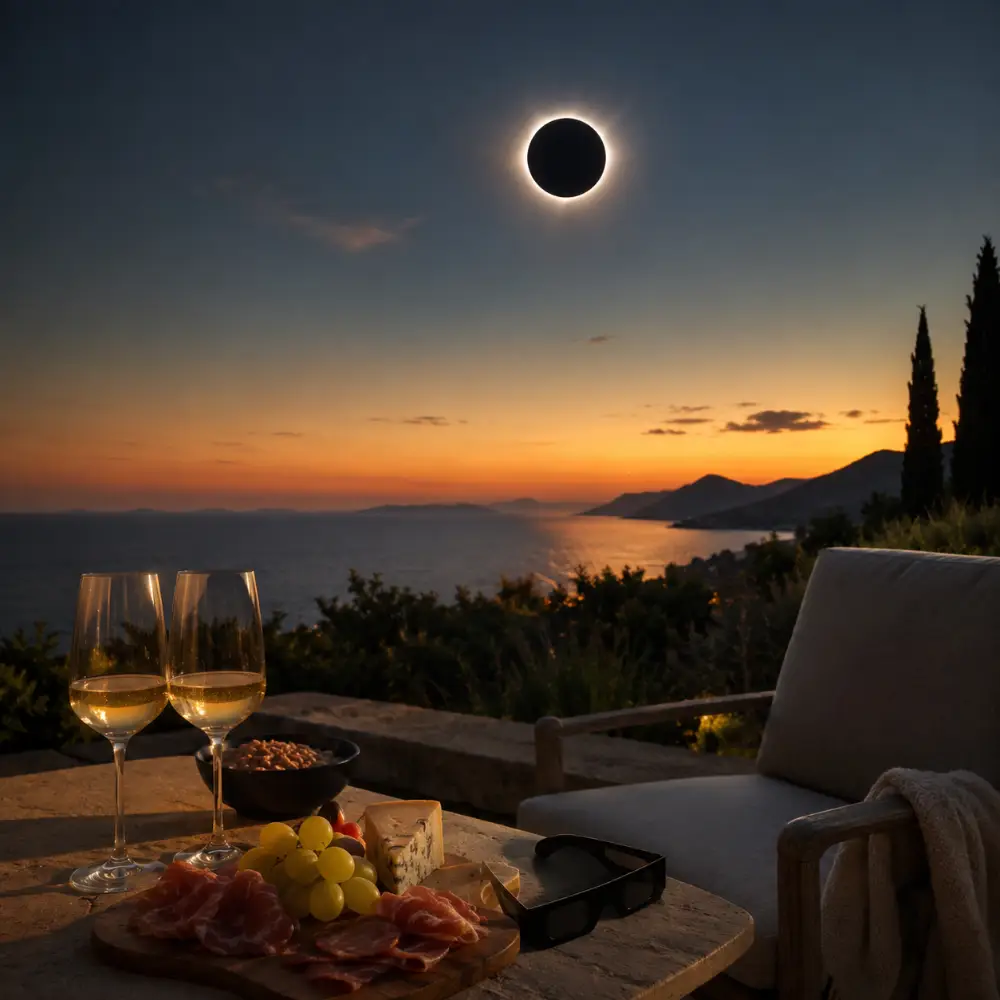
Set out a comfortable outdoor chair. Bring a light cashmere cardigan for the cooler evening air. Pour a glass of Franciacorta, Champagne or a chilled white Burgundy. Keep a small plate of salted almonds, Parmesan shavings or delicate crostini nearby.
Then put the phone away.
A Solar Eclipse Needs the Right Kind of Glasses
There is one piece of equipment that is absolutely non-negotiable: proper solar eclipse glasses or a certified solar viewing filter.
Ordinary sunglasses, however dark, are not suitable. Neither are cameras, binoculars or telescopes unless they are fitted with the appropriate solar filter. Looking directly at the partially eclipsed Sun can cause serious and potentially permanent eye damage.
The reason is slightly counterintuitive. During a partial eclipse, the Sun can appear considerably less dazzling because much of its disc is covered. Yet the remaining crescent is still intensely bright. The reduced sensation of glare does not make it safe to look at.
For photography, the same principle applies. A camera sensor can be damaged by direct sunlight, particularly when using a telephoto lens. Anyone planning to photograph the eclipse should use a purpose-made solar filter designed for the equipment being used.
For most people, however, the simplest approach is the best: certified eclipse glasses, a comfortable viewpoint and your own eyes kept safely behind the filter.
The Art of Watching, Rather Than Recording
There will inevitably be thousands of photographs of today’s eclipse. Some will be technically astonishing. Others will capture the strange beauty of a landscape changing beneath an unfamiliar sky.
But there is a case for taking fewer photographs yourself.
The most memorable part of an eclipse is not necessarily the image it produces. It is the sensation of watching the world alter in real time.
Notice the quality of the light on a building. Look at the shadows beneath a tree. Watch how the colour of the landscape changes. Listen to the birds and notice whether their behaviour shifts as daylight fades. Look at the faces of the people around you.
Then, for a few minutes, leave the camera alone.
A good compromise is to take a handful of photographs before and after the maximum eclipse, then concentrate on the experience itself.
For those who enjoy photography, a tripod and manual exposure settings will give considerably more control than a smartphone held casually towards the sky. A wide-angle lens can capture the eclipse within its landscape, while a telephoto lens gives a more intimate view of the Sun and Moon.
The latter requires considerably more care, making it an enjoyable project for experienced photographers rather than something to improvise.
The Luxury of the Perfect Eclipse Setting
For the ultimate eclipse experience, location makes all the difference.
Northern Spain is particularly compelling this year because the path of totality crosses the country. Parts of Spain will experience the Moon completely covering the Sun, turning daylight into an extraordinary twilight and revealing the Sun’s corona around the dark silhouette of the Moon.
Iceland offers another spectacular possibility, particularly for those drawn to dramatic landscapes. Imagine watching totality against volcanic mountains, black beaches or a wide Atlantic horizon. Greenland, meanwhile, offers a much more remote interpretation of the same phenomenon.
For a luxury-minded traveller, this is precisely the kind of occasion that rewards a beautifully chosen setting rather than an overcrowded itinerary. A discreet countryside hotel, a private villa outside a Spanish town or a carefully positioned Icelandic retreat can turn the eclipse into an entire experience.
The important detail is the horizon. Totality is brief, and even in the path of totality the Sun may be relatively low in the sky. A clear western or south-western horizon can be more valuable than a five-star postcode.
What to Serve During an Eclipse
There is no need for an elaborate menu.
The mood calls for something Mediterranean and uncomplicated: a plate of Jamón Ibérico, Manchego and Marcona almonds, perhaps accompanied by grilled sourdough and a little extra-virgin olive oil.
For drinks, keep the evening light. A chilled Cava or Franciacorta works beautifully, while a crisp Albariño or elegant Vermentino suits the late-summer atmosphere.
If you are staying at home, make an aperitivo of it. Prepare everything beforehand so that the moment the light begins to change, you are not standing in the kitchen searching for a corkscrew.
There is a particular pleasure in having everything ready before nature takes over the schedule.
Beyond the Eclipse: Stay for Sunset
Perhaps the most beautiful way to finish the evening is simply to stay outside.
Once the eclipse has passed, resist the temptation to immediately return indoors. Let the Sun continue its descent. In parts of western Europe, the eclipse coincides with the late afternoon and evening light, creating the possibility of an unusual sunset sequence. NASA notes that along parts of the western eclipse path, the Sun will set while still partially eclipsed.
This is where the experience becomes wonderfully cinematic.
The sky moves from bright afternoon to gold, then rose, then the deeper blue of evening. Glasses are emptied. Conversation becomes quieter. The extraordinary event gradually becomes an ordinary evening again.
And perhaps that is the real pleasure of an eclipse.
Not that it changes your life. Not that it needs to become a metaphor for everything. Simply that, for a short while, something remarkable happens above you, and you are there to see it.
A Moment Worth Savouring
A solar eclipse is one of those rare experiences that asks very little of us.
No complicated itinerary. No reservation. No sophisticated equipment unless you want it. Just a safe view of the sky and the willingness to stop for a while.
Tonight, the Moon will cross the face of the Sun. In some places, daylight will briefly disappear. In others, including the Netherlands, the afternoon light will become strangely muted as the Moon covers much of the solar disc.
So pour something lovely, take your seat and look towards the sky.
For once, there is nowhere else to be.