
Why Tai Chi may be the most transformative thing you do after 50 and how to start today.
“In stillness, find movement. In movement, find stillness.”
That ancient paradox sits at the heart of Tai Chi a practice that seems almost too gentle to matter, until the day you realise it has quietly changed everything. There’s a particular kind of freedom that arrives in our fifties. The frenetic ambitions of earlier decades begin to soften, and something deeper surfaces a longing for practices that nourish rather than deplete, that restore rather than exhaust. Tai Chi, the ancient Chinese movement art, answers that longing with breathtaking elegance.
Often described as “meditation in motion,” Tai Chi (or Tàijíquán) traces its roots back over 400 years to Chen Village in Henan, China. Originally a martial art, it evolved into a flowing sequence of postures and transitions practised with mindful, unhurried attention. Today, millions of people worldwide, the majority of them over 50, practise it in parks, community halls, and living rooms.
What makes Tai Chi particularly compelling for those in the second half of life is its profound adaptability. Whether you are a seasoned athlete or have never set foot in a gym, whether you have stiff joints or chronic pain, Tai Chi meets you exactly where you are. No special equipment, no competition, no punishing regimen, just you, your breath, and the slow, purposeful choreography of your own body.
Science, too, has caught up with what Chinese practitioners have known for centuries. A growing body of research confirms that regular Tai Chi practice delivers a remarkable range of benefits physical, cognitive, and emotional that make it one of the wisest investments you can make in yourself after 50.
SIX WAYS TAI CHI TRANSFORMS LIFE AFTER 50
- Balance & Fall Prevention
Falls are the leading cause of injury in older adults. Tai Chi’s slow, weight-shifting movements retrain proprioception, the body’s sense of where it is in space dramatically reducing fall risk. Studies show regular practice can cut falls by up to 45%.
- Joint Health & Flexibility
Unlike high-impact exercise, Tai Chi is gentle on cartilage and connective tissue. Its slow, circular movements lubricate the joints, increase range of motion, and have been shown to significantly ease the pain and stiffness of arthritis.
- Heart & Blood Pressure
A consistent Tai Chi practice has been linked to lower systolic blood pressure, improved heart rate variability, and reduced inflammation making it a powerful, medication-free ally for cardiovascular health.
- Cognitive Sharpness
The mental challenge of memorising sequences, coordinating movement with breath, and maintaining mindful awareness provides rich stimulation for the brain. Research links regular Tai Chi to better memory, sharper focus, and a reduced risk of cognitive decline.
- Stress & Sleep
Tai Chi activates the parasympathetic nervous system the body’s “rest and digest” mode lowering cortisol levels. Practitioners consistently report deeper sleep, reduced anxiety, and a lasting sense of calm that carries through the day.
- Posture & Core Strength
Every movement in Tai Chi originates from the core and demands upright, aware posture. Over time, this quietly rebuilds the muscular foundation that supports your spine, reducing back pain and lending you a natural elegance of carriage.
“Tai Chi does not demand that you be younger, faster, or stronger. It simply asks that you show up, move with intention, and breathe. That is enough, and it turns out to be everything.”
WHAT DOES A TAI CHI SESSION ACTUALLY FEEL LIKE?
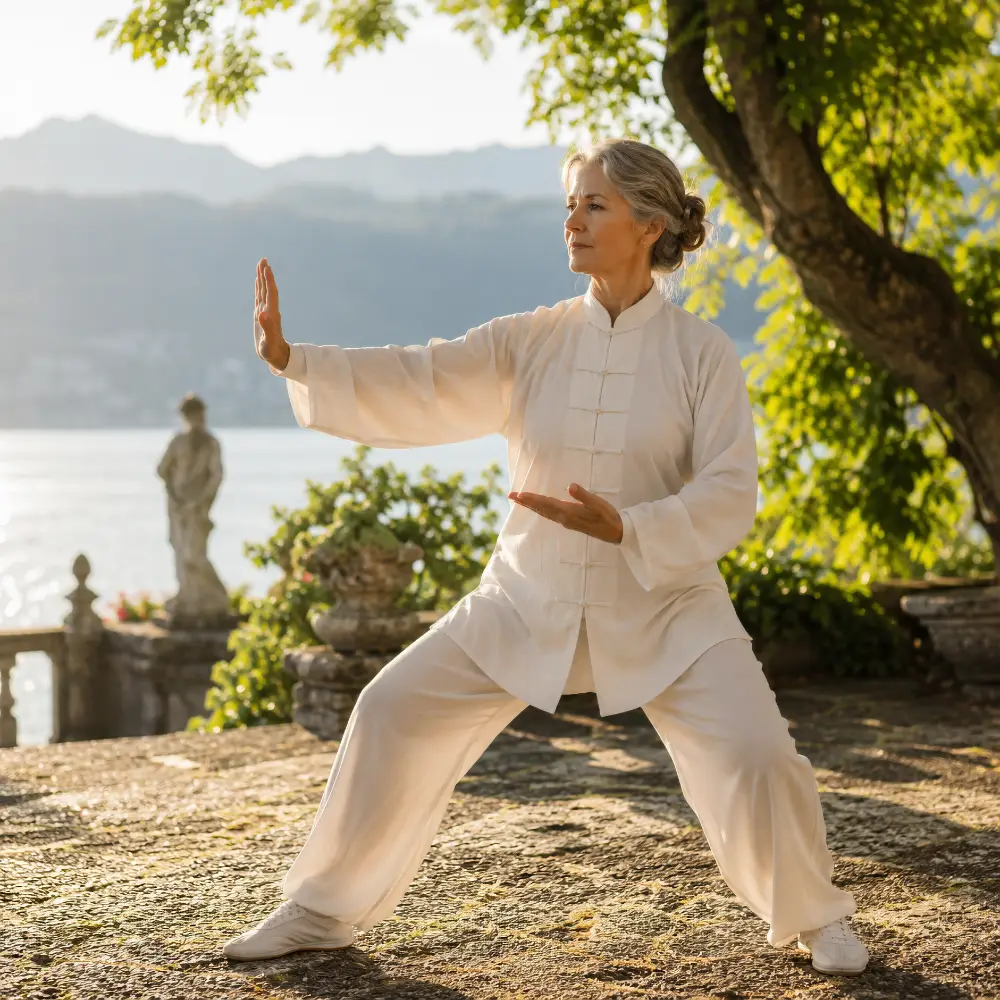
Imagine standing barefoot or in soft shoes on a dewy lawn at dawn. You begin to move, not abruptly, but as if the air itself is guiding you. One arm rises like the wing of a crane. Your weight transfers, unhurried, from one foot to the other. Your breath deepens without effort. The world grows quiet.
A typical session lasts 20 to 60 minutes and flows through a “form” a sequence of named postures with evocative titles like Grasp the Sparrow’s Tail, Wave Hands Like Clouds, and Golden Rooster Stands on One Leg. Beginners often start with 8 or 24 movements; advanced forms may include 108. The movements are always slow, always continuous, always connected to the breath.
There is no straining. No sweat-soaked floors. And yet, after a session, something unmistakable has shifted you feel simultaneously energised and deeply at ease, as if you have been both exercised and restored at the same time. This is the particular magic of Tai Chi, and it never entirely loses its ability to surprise you.
HOW TO BEGIN – WITHOUT OVERWHELM
The good news: Tai Chi has one of the most welcoming on-ramps of any movement practice. Here is how to step onto it gracefully.
- Find a class, not a video
While online resources are plentiful, starting with a local class or a qualified instructor is invaluable. A teacher can correct your alignment, answer questions, and offer the sense of community that makes any practice sustainable. Look for classes at community centres, yoga studios, or dedicated Tai Chi schools. Many offer free introductory sessions.
- Choose the right style
The most popular styles for beginners are Yang (gentle, expansive movements ideal for those with joint concerns) and the simplified 24-form (created specifically to be accessible and learnable within a few months). Ask your instructor which they teach and why a good teacher will have a thoughtful answer.
- Dress for ease, not performance
Loose, comfortable clothing and flat shoes (or bare feet) are all you need. Traditional Tai Chi shoes are lovely but entirely optional. The only thing that matters is that nothing restricts your movement or your breathing.
- Commit to small and consistent
Even 15 minutes daily outperforms a 90-minute class once a fortnight. Tai Chi rewards regularity above intensity. Many practitioners find that a short morning session even just running through the form once in their garden becomes the quiet anchor of their day.
- Release the need to “get it right”
Perhaps the most Italian piece of advice we can offer: approach it with a spirit of curiosity rather than achievement. Tai Chi is not a performance. There is no audience. The form is simply a structure within which you practise being present. That is the entire point and it takes a lifetime of happy exploration to fully appreciate.
AGEING WELL IS AN ART FORM
La Dolce Vita has always been about the art of living well not in spite of the passage of time, but in full, joyful collaboration with it. Tai Chi embodies that philosophy perhaps better than any other practice we know. It does not promise to make you younger. It offers something richer: a way of inhabiting your body with awareness, with grace, and with a growing sense of ease that only deepens the more you practise.
The ancient masters described Tai Chi as “the grand ultimate” a movement practice that synthesises opposing forces into flowing harmony. After 50, when the harmony we seek is less about conquest and more about coexistence with our bodies, our histories, our changing selves that description feels exactly right.
All you have to do is begin. Slowly. Beautifully. On your own time.